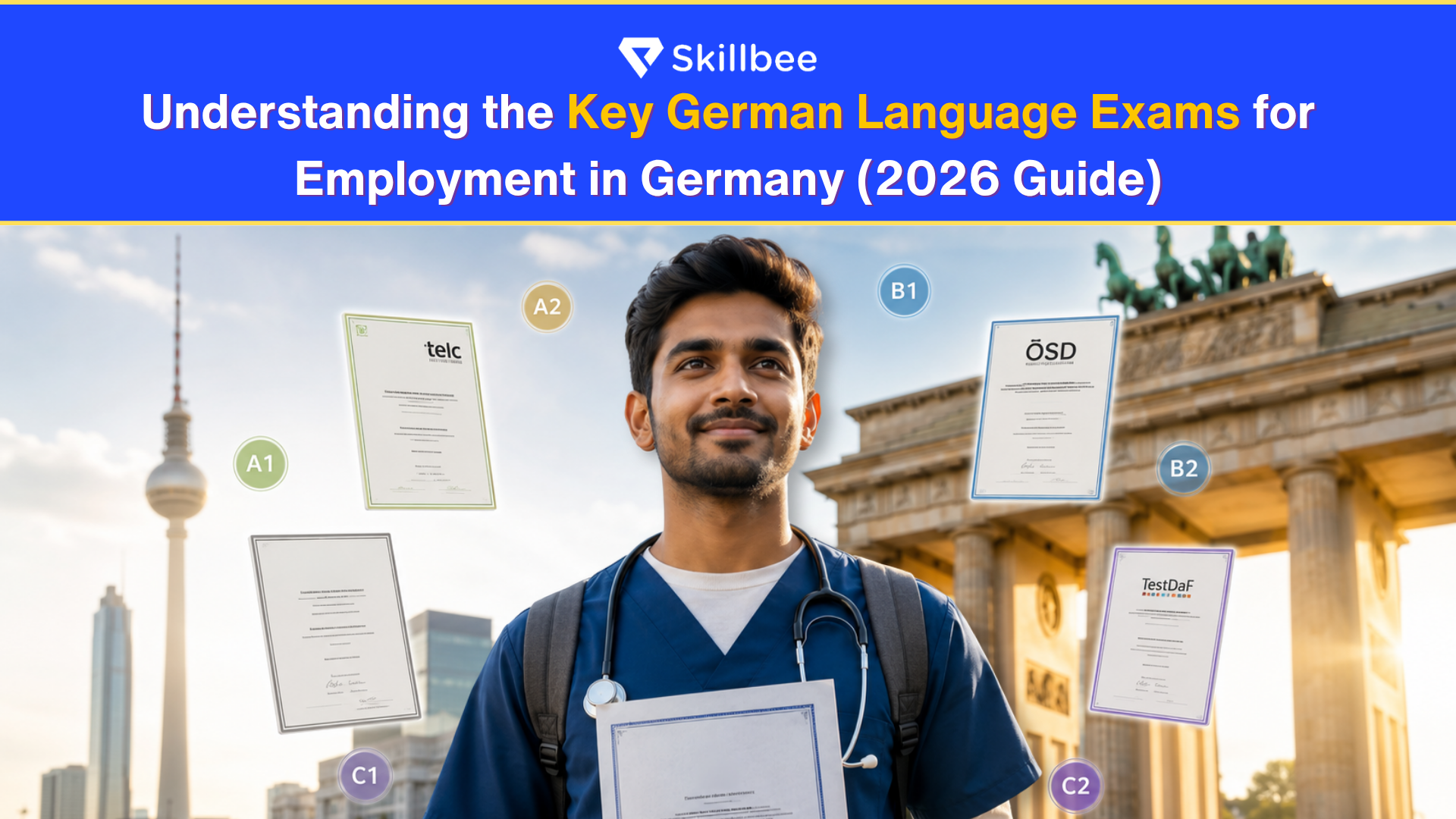
Germany is one of the world’s leading destinations for skilled professionals, offering excellent career opportunities, competitive salaries, and a high quality of life. However, securing a job in Germany requires more than technical qualifications; strong German language skills are essential for most professions. Employers expect candidates to communicate effectively with colleagues, customers, and patients, while regulated professions such as nursing often require certified language proficiency. To demonstrate these skills, candidates must pass a recognized German language exam that assesses reading, writing, listening, and speaking abilities.
When looking for the best German language exam for working in Germany, professionals will find that several options stand out. Among the top German language certifications for Germany, the four most widely accepted are Goethe, TELC, ÖSD, and TestDaF. Whether you are preparing through a German online test or taking an in-person assessment, this blog will compare these options, explain their recognition, and help you choose the right certification based on your career goals.
Why German Language Skills Matter for Employment in Germany

German language proficiency is more than just a requirement for obtaining a work visa or meeting employer expectations; it is an important skill for building a successful career in Germany. While professional qualifications and work experience can help you secure your interviews, strong communication skills often determine how well you perform in the workplace and adapt to your new environment.
Although some multinational companies use English as their primary business language, these opportunities are mostly limited to sectors like IT, technology, and consulting. Most industries in Germany, including healthcare, logistics, manufacturing, hospitality, retail, and public services, rely on German for daily communication. Employees are expected to understand instructions, follow safety procedures, complete documentation, and interact confidently with colleagues and customers.
For professionals working in regulated fields such as healthcare, language skills are even more important. Nurses, for example, communicate with patients, doctors, and medical teams throughout the day. They must accurately understand medical information, explain treatments, and maintain patient records. This is why many German states require nurses to demonstrate B2-level German language proficiency before they can begin working.
To prove these abilities, candidates frequently look for the best German language exam for working in Germany that fits their specific medical or vocational background. Many prospective applicants choose to practice their reading and listening sections beforehand by taking a German online test to ensure they are ready for official German language exams.
Beyond the workplace, speaking German makes everyday life much easier. Whether you’re opening a bank account, renting accommodation, visiting a doctor, or dealing with government offices, language skills help you navigate daily tasks with confidence. They also make it easier to connect with local communities and settle into life in Germany.
From an employer’s perspective, candidates with certified German language skills are often more attractive because they can integrate into the workplace faster and require less language support. A recognized German language certificate not only strengthens your job application but also demonstrates your commitment to working and living successfully in Germany.
Understanding German Language Levels (A1–C2)

Before choosing a German language exam, it’s important to understand how language proficiency is measured. Most internationally recognized German language certifications for Germany follow the Common European Framework of Reference for Languages (CEFR). This international standard classifies language skills into six levels, from beginner (A1) to near-native proficiency (C2). These levels help employers, universities, and government authorities assess a candidate’s ability to communicate in German.
| Level | Description |
| A1 | Beginner |
| A2 | Elementary |
| B1 | Intermediate |
| B2 | Upper Intermediate |
| C1 | Advanced |
| C2 | Near-native proficiency |
The German language exams are structured according to the Common European Framework of Reference for Languages (CEFR), which measures proficiency across six levels from A1 to C2. Understanding these levels helps candidates choose the right exam and prepare according to their career requirements in Germany.
The A1 and A2 levels are designed for beginners who are learning basic vocabulary and everyday communication. At these levels, learners can introduce themselves, ask simple questions, and handle routine conversations. While these skills are useful for daily life, they are generally not enough for most professional roles in Germany.
The B1 level marks the transition to independent language use. Candidates can understand common workplace conversations, read everyday documents, and communicate on familiar topics with reasonable confidence. Some entry-level jobs and vocational training programmes accept B1 proficiency, depending on the employer and profession.
For many professions, B2 is the preferred level because it enables candidates to communicate confidently in professional environments. Healthcare professionals, particularly nurses, are often required to demonstrate B2 proficiency in German to interact effectively with patients, colleagues, and medical teams.
The C1 and C2 levels are intended for advanced users who need a high degree of fluency for academic studies, research, management, or specialised careers. Understanding these CEFR levels will help you select the most suitable test and meet the language requirements of your chosen profession in Germany.
Overview of the Four Key German Language Exams
Germany recognizes several German language exams and certifications, but Goethe-Zertifikat, TELC, ÖSD, and TestDaF are the four most widely accepted for employment and professional purposes. All of these exams assess the four essential language skills: reading, writing, listening, and speaking, based on the CEFR language proficiency levels. However, each exam is designed to meet different educational and career needs.
For professionals planning to work in Germany, Goethe-Zertifikat and TELC are among the most popular choices because they focus on practical communication used in everyday life and the workplace. ÖSD is also widely recognized across Germany and other German-speaking countries, making it a suitable option for those seeking broader regional recognition. In contrast, TestDaF is primarily intended for students and professionals pursuing higher education or academic careers in Germany.
Choosing the right certification depends on your profession, the language level required by your employer or institution, and your long-term goals. Understanding the purpose and recognition of each exam will help you select the certification that best supports your career aspirations in Germany.
Goethe-Zertifikat

The Goethe-Zertifikat is one of the most recognized German language certifications for Germany, making it a top choice when evaluating Goethe vs TELC vs ÖSD vs TestDaF. Offered by the Goethe-Institut, Germany’s official cultural institute, it is accepted by employers, universities, immigration authorities, and government institutions. Its global recognition makes it a popular choice for candidates planning to work, study, or settle in Germany.
The exam is available across all CEFR levels (A1–C2), allowing learners to choose a test that matches their language proficiency. It evaluates the four core language skills—reading, listening, writing, and speaking—to assess a candidate’s ability to communicate effectively in both everyday and professional situations.
One of the biggest advantages of the Goethe-Zertifikat is its broad acceptance across industries in Germany. It is particularly suitable for skilled professionals, nurses, engineers, students, and other job seekers who need a trusted and internationally recognized proof of German language proficiency for employment, higher education, visa applications, or long-term career opportunities in Germany.
TELC (The European Language Certificates)

TELC (The European Language Certificates) is a widely recognized option when comparing Goethe vs TELC vs ÖSD vs TestDaF, accepted by employers, hospitals, vocational schools, and government institutions across Germany. Unlike general language exams, TELC offers profession-specific certifications, making it an excellent choice for candidates pursuing careers in healthcare, business, and vocational fields.
TELC exams are available at all CEFR levels (A1–C2) and assess the four core language skills: reading, listening, writing, and speaking. In addition to general German exams, TELC offers specialized certifications such as TELC Deutsch B2 Beruf, TELC Deutsch B2 Pflege, and TELC Deutsch Medizin, which focus on practical workplace communication.
One of TELC’s biggest strengths is its emphasis on real-life professional scenarios, allowing candidates to demonstrate language skills relevant to their jobs. It is particularly popular among nurses and healthcare professionals, as many German employers recognize TELC B2 Pflege as proof of the communication skills needed to work effectively in hospitals, clinics, and nursing homes.
ÖSD (Österreichisches Sprachdiplom Deutsch)

ÖSD (Österreichisches Sprachdiplom Deutsch) is an internationally recognized option when evaluating Goethe vs TELC vs ÖSD vs TestDaF, developed in Austria and accepted across German-speaking countries, including Germany, Austria, and Switzerland. It follows the Common European Framework of Reference for Languages (CEFR) and focuses on practical communication skills used in everyday life and professional settings.
ÖSD exams are available at all CEFR levels (A1–C2) and assess the four key language skills—reading, listening, writing, and speaking. The exam is designed to evaluate how well candidates can communicate in real-life situations, making it suitable for both personal and workplace environments.
Although it is an Austrian certification, ÖSD is widely recognized by German employers, universities, and public institutions. It is a good choice for skilled professionals, students, and individuals planning to work or study in Germany or Austria, particularly those seeking a certification with broad acceptance across German-speaking countries.
TestDaF (Test Deutsch als Fremdsprache)

TestDaF (Test Deutsch als Fremdsprache) is a standardized German language exam often evaluated alongside Goethe vs TELC vs ÖSD vs TestDaF when candidates look for the right academic path. It is designed primarily for international students and professionals who need advanced academic German. Unlike Goethe-Zertifikat or TELC, which focus on everyday and workplace communication, TestDaF emphasizes the language skills required for university studies, research, and specialized professions.
The exam assesses CEFR B2 to C1 proficiency and evaluates the four core language skills—reading, listening, writing, and speaking. The tasks are based on academic scenarios, such as understanding lectures, analyzing texts, writing structured responses, and presenting arguments.
TestDaF is widely recognized by German universities and many research institutions, making it one of the most accepted certifications for higher education in Germany. It is best suited for students, researchers, engineers, doctors, and professionals pursuing academic or specialized careers. Candidates seeking general employment in Germany may find Goethe-Zertifikat or TELC more suitable, as they focus on practical workplace communication.
Comparison of the Four German Language Exams
Choosing the right German language exams can seem overwhelming, especially when all four certifications are recognized in Germany. When evaluating Goethe vs TELC vs ÖSD vs TestDaF, the good news is that there is no single “best” exam for everyone. Instead, finding the best German language exam for working in Germany depends on your career goals, profession, education plans, and the specific requirements of your employer or institution.
While all four German language certifications for Germany assess reading, writing, listening, and speaking skills according to the Common European Framework of Reference for Languages (CEFR), they differ in terms of focus. Some tests are designed for everyday and workplace communication, while others are intended for academic study or profession-specific language requirements.
Before registering for an official assessment, it’s important to verify whether your employer, university, or licensing authority prefers a particular certification. Doing so can save you time, money, and unnecessary preparation.
| Feature | Goethe-Zertifikat | TELC | ÖSD | TestDaF |
| CEFR Levels | A1–C2 | A1–C2 | A1–C2 | B2–C1 |
| Accepted by German Employers | ✔ | ✔ | ✔ | ✔ (mainly academic/professional) |
| Accepted by Universities | ✔ | Some institutions | ✔ | ✔ |
| Healthcare-Specific Exams | No | ✔ | No | No |
| Suitable for Work Visa Applications | ✔ | ✔ | ✔ | Sometimes |
| Best For | General employment | Healthcare & vocational careers | Germany & Austria | University & research |
| Global Recognition | Excellent | Excellent | Very Good | Excellent |
Although all four German language exams are respected, the Goethe-Zertifikat and TELC are generally the most popular choices among professionals seeking employment in Germany. If you are comparing Goethe vs TELC vs ÖSD vs TestDaF, the ÖSD serves as an excellent option for those planning to work across multiple German-speaking countries, while TestDaF remains better suited for candidates pursuing higher education or specialized academic careers.
Which German Language Exam Should You Choose?

The best German language exams depends on your individual career path and long-term plans. Before choosing the German language exams, consider why you need the certificate and where you intend to use it.
If you’re planning to work in Germany across most industries, the Goethe-Zertifikat is one of the safest choices. It is internationally recognized, accepted by employers, universities, and immigration authorities, and suitable for a wide range of professions. Whether you’re applying for a work visa or looking for long-term employment, Goethe certification is widely respected.
If you’re a healthcare professional, particularly a nurse, TELC may be the better option. Specialized German language exams such as TELC Deutsch B2 Pflege are designed specifically for healthcare environments and evaluate the communication skills required when interacting with patients, doctors, and colleagues. Many hospitals and healthcare employers in Germany are familiar with TELC certifications.
Candidates planning to study at a German university or pursue research and highly specialized professions should consider TestDaF. Since the German language exams focus on academic German, it is accepted by many universities as proof of language proficiency and prepare candidates for higher education.
If your career plans include working in both Germany and Austria, ÖSD can be a practical choice. Because it is recognized across German-speaking countries, it provides flexibility for professionals considering opportunities in multiple regions.
Ultimately, whichever German language exams you choose, the most important factor is achieving the language level required for your profession. A certificate alone does not guarantee employment, but strong communication skills combined with the right qualifications significantly improve your chances of building a successful career in Germany.
Tips for Preparing for German Language Exams

Preparing for a German language exams requires consistent practice and a well-planned study routine. Rather than focusing only on grammar rules, candidates should aim to develop all four language skills equally: reading, writing, listening, and speaking. A balanced approach will not only improve German language exams performance but also prepare you for real-life communication in Germany.
One of the most effective ways to prepare is by creating a daily study schedule. Even 30 to 60 minutes of focused practice each day can lead to significant improvement over time. Consistency is far more effective than studying for long hours only occasionally.
Reading German newspapers, magazines, blogs, and short articles helps expand vocabulary and improves reading comprehension. At the same time, listening to German podcasts, news broadcasts, or videos allows learners to become familiar with different accents, pronunciation, and natural speech patterns.
Speaking practice is equally important. Candidates should try to communicate regularly with teachers, language partners, or fellow learners. The more frequently you speak German, the more confident you’ll become during the speaking section of the exam and in real workplace situations.
Writing practice should also be part of your preparation. Practice writing emails, letters, reports, and short essays while paying attention to grammar, sentence structure, and vocabulary. Many exams require candidates to complete practical writing tasks that resemble workplace communication.
Finally, take several mock tests before your actual examination. Practising under timed conditions helps you become familiar with the German language exams format, manage your time effectively, and identify areas where additional improvement is needed. Candidates who understand the structure of the German language exams often feel more confident and perform better on test day.
Conclusion
Choosing the right German language exams is an important step towards building a successful career in Germany. Whether you opt for Goethe-Zertifikat, TELC, ÖSD, or TestDaF, each German language exams and certification is recognized for different purposes and can strengthen your employment or academic prospects. The best choice depends on your profession, career goals, and the language requirements of your employer or institution. Investing time in learning German and earning a recognized language certificate not only improves your job opportunities but also helps you integrate confidently into life and work in Germany.
If you’re an Indian nurse aspiring to work in Germany, Skillbee can support you throughout your journey. From providing German language training to helping you prepare for employer interviews, Skillbee equips candidates with the skills needed to succeed in Germany’s healthcare sector. The team also assists with the visa application, documentation, and relocation process, making the transition smoother and less stressful. With end-to-end guidance and dedicated support, Skillbee helps Indian nurses take the next step towards building a rewarding healthcare career in Germany.
 +91 73 6009 6009 (India)
 contact@skillbee.com
Leave a Reply