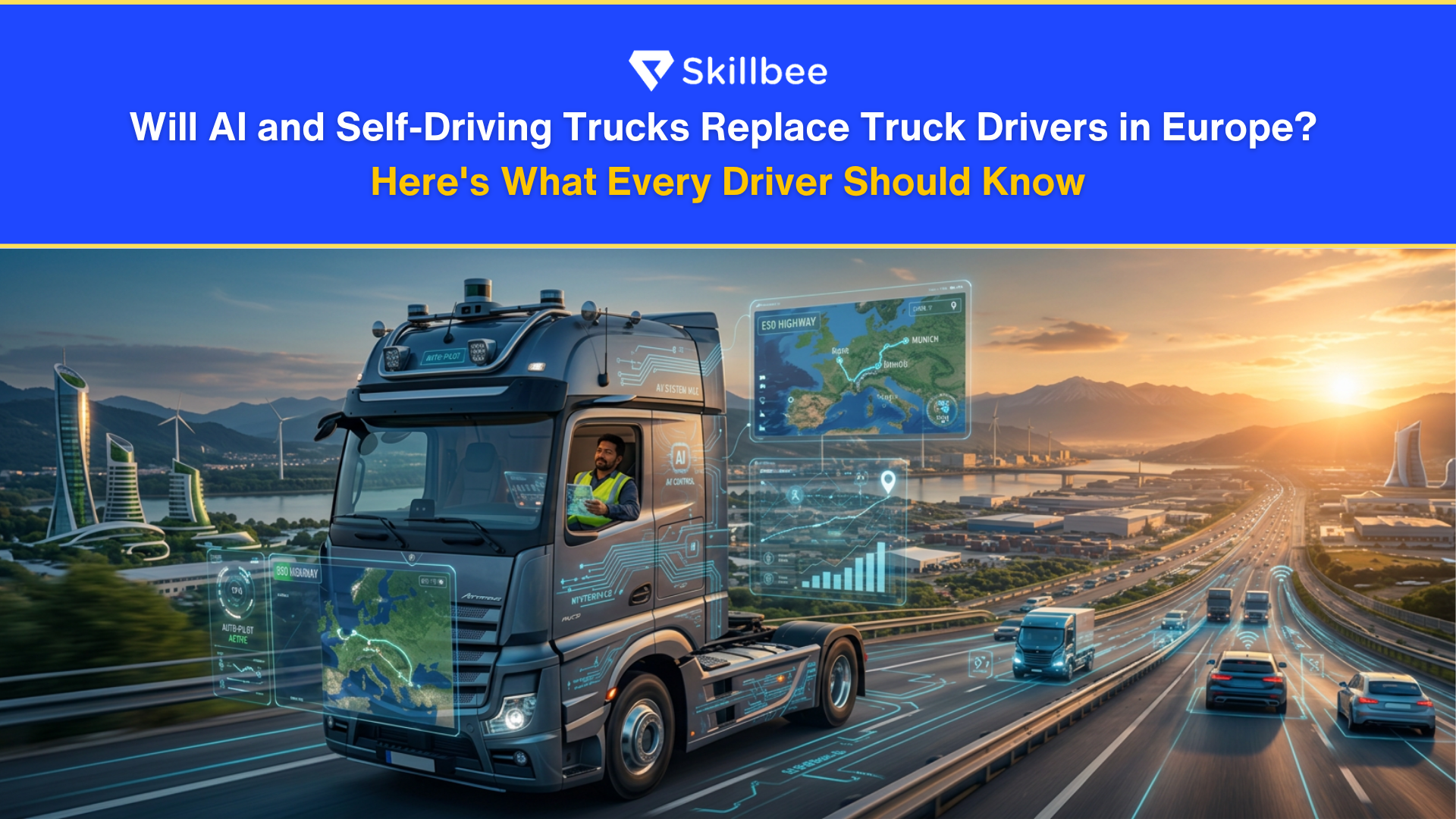
The rapid advancement of autonomous driving technology has sparked an important question across the transport industry: Will AI and self-driving trucks replace truck drivers? As autonomous trucks in Europe continue to evolve, modern commercial vehicles are being equipped with advanced features like adaptive cruise control, lane-keeping assistance, automatic emergency braking, and AI-powered route planning. These innovations are improving safety and efficiency, but they have also left many professional drivers wondering what the future holds.
While AI is transforming the trucking industry, it is designed to support, not replace, skilled truck drivers. Commercial trucking involves far more than driving, including managing cargo, adapting to changing road conditions, and complying with transport regulations. In this article, we’ll explore the current capabilities and limitations of autonomous trucks in Europe and why professional drivers remain essential to the industry’s future.
What Does ‘Self-Driving’ Actually Mean?

The term “self-driving” is often used to describe vehicles that can perform certain driving functions without constant input from the driver. However, not every self-driving system offers the same level of automation. This is an important distinction when discussing autonomous trucks in Europe, as many people assume these vehicles can already operate without human involvement.
Most vehicles available today, including those equipped with advanced technologies like Tesla’s Full Self-Driving (Supervised), are not fully autonomous. Instead, they rely on driver assistance systems that support tasks such as steering, braking, accelerating, and maintaining a safe distance from other vehicles. Even with these advanced features, the driver must remain attentive, stay ready to take control at any moment, and remain legally responsible for operating the vehicle safely.
Vehicle automation is generally divided into different levels, starting from Level 0, where the driver performs every driving task, and going up to Level 5, where a vehicle is capable of driving itself under all road and weather conditions without any human intervention. Most autonomous trucks in Europe currently operate at Level 2, meaning they can assist with several driving functions but are not capable of replacing the driver.
How AI Is Already Being Used in the Trucking Industry
Artificial intelligence is already making a meaningful impact on the trucking industry, but its primary role is to support drivers rather than replace them. This is especially true for autonomous trucks in Europe, where AI is being used to improve safety, efficiency, and fleet operations while keeping professional drivers in control.
One of the most widely used technologies is Advanced Driver Assistance Systems (ADAS). Features such as Adaptive Cruise Control (ACC) automatically adjust the truck’s speed to maintain a safe following distance, while Lane Keeping Assistance helps prevent unintended lane departures by providing steering support or driver alerts.
Another important innovation is Automatic Emergency Braking (AEB), which detects potential collisions and can automatically apply the brakes if the driver fails to react in time. Many modern trucks also include driver fatigue monitoring systems that analyse driving behaviour and encourage drivers to take breaks before fatigue becomes a safety risk.
Beyond safety, AI helps transport companies improve efficiency. Route optimisation systems use real-time traffic and road data to recommend faster routes, while fuel optimisation tools analyse driving patterns and terrain to reduce fuel consumption and operating costs.
These advancements often lead people to ask, “Will AI replace truck drivers?” The answer, at least for now, is no. While autonomous trucks in Europe are becoming smarter, they still rely on skilled drivers to manage cargo, adapt to changing road conditions, comply with transport regulations, and make critical decisions in unpredictable situations. AI is enhancing the profession, not replacing it.
Why Truck Driving Is Difficult to Fully Automate
Although artificial intelligence has advanced rapidly over the past few years, fully automating commercial truck driving is still a long way from becoming a reality. This is one of the biggest reasons why the answer to “Will AI replace truck drivers?” remains no. While autonomous trucks in Europe continue to evolve, today’s technology cannot replicate the experience, judgment, and decision-making required for commercial trucking.
One of the biggest challenges is dealing with constantly changing weather and road conditions. Heavy rain, snowfall, dense fog, strong crosswinds, and icy roads can all have a significant impact on a truck’s handling, braking distance, and visibility. Experienced drivers know when to slow down, adjust their braking, or change their driving style to stay safe—something current AI systems still struggle to do consistently in real-world conditions.
Managing cargo is another responsibility that goes far beyond driving. Commercial truck drivers transport refrigerated goods, hazardous materials, oversized cargo, and fragile shipments, each with its own handling procedures and safety requirements. These tasks require careful human supervision throughout the journey.
Loading and unloading also remain difficult to automate. Warehouses, ports, and distribution centres are busy environments with pedestrians, forklifts, tight spaces, and constantly changing layouts. Successfully manoeuvring large commercial vehicles in these conditions requires precision, communication, and adaptability.
Professional drivers must also respond to unexpected situations such as road accidents, traffic congestion, vehicle breakdowns, road closures, and emergency diversions. These scenarios demand real-time decision-making based on experience, an area where AI still falls short.
For international truck drivers, the job extends beyond driving. They must comply with transport regulations across multiple countries, follow driving and rest hour rules, manage customs procedures, complete documentation, and meet country-specific legal requirements. These responsibilities cannot yet be handled independently by autonomous trucks in Europe.
For all of these reasons, AI should be viewed as a tool that supports drivers rather than replaces them. So, will AI replace truck drivers? Not anytime soon. Automation can assist with certain driving tasks, but skilled professionals remain essential for safely managing the many responsibilities involved in commercial trucking.
Will AI Replace Truck Drivers in Europe?
The simple answer is no—not anytime soon.
Although artificial intelligence and automation are reshaping the transport industry, autonomous trucks in Europe are not expected to replace professional truck drivers in the foreseeable future. Europe continues to face a significant shortage of qualified drivers due to an ageing workforce, rising freight demand, and fewer young people entering the profession. As a result, skilled drivers remain essential to keeping Europe’s supply chains moving.
Current regulations also reinforce the need for human drivers. Even trucks equipped with advanced driver assistance systems or semi-autonomous technology still require a qualified driver to remain in control. The driver is legally responsible for monitoring the road, responding to changing traffic conditions, and taking over whenever necessary.
So, will AI replace truck drivers? Rather than replacing them, AI is more likely to automate specific tasks such as route planning, traffic analysis, predictive maintenance, fuel optimisation, and driving assistance. However, responsibilities like securing cargo, complying with transport regulations, completing customs procedures, communicating with customers, and making real-time decisions still depend on human expertise.
As autonomous trucks in Europe continue to evolve, the role of truck drivers will also change. Drivers will increasingly work alongside smarter vehicles and digital systems, using technology to improve safety and productivity. Those who embrace new technologies while building their professional skills will continue to be highly valued by employers across Europe.
Skills That Will Become More Important for Truck Drivers

As autonomous trucks in Europe become more advanced, truck drivers will need to expand their skills alongside their driving experience. Learning new technologies and adapting to industry changes will help drivers stay competitive and prepare for the future of transport.
One of the most important skills is understanding how to use Advanced Driver Assistance Systems (ADAS). Features such as Adaptive Cruise Control, Lane Keeping Assistance, collision warning systems, and automatic emergency braking are designed to support drivers, not replace them. Using these systems effectively can improve both safety and efficiency.
Professional drivers should also stay up to date with European transport regulations, including driving and rest hour rules, digital tachograph requirements, vehicle compliance standards, and country-specific road laws. Digital skills are equally valuable, as many transport companies rely on mobile apps for navigation, route planning, electronic documentation, and fleet management.
If you’re wondering whether AI will replace truck drivers, the answer lies in the skills drivers continue to develop. Strong driving fundamentals, safe driving practices, vehicle inspections, and the ability to work alongside modern technology will remain essential. By combining experience with digital knowledge, truck drivers can build long-term careers and stay in high demand as autonomous trucks in Europe continue to evolve.
Conclusion
Artificial intelligence is undoubtedly transforming the trucking industry, making commercial vehicles safer, smarter, and more efficient than ever before. However, despite these technological advancements, today’s AI is designed to support professional drivers, not replace them. While automation can assist with certain driving tasks and improve fleet operations, commercial trucking still relies heavily on human experience, practical judgment, and the ability to respond to complex real-world situations that technology cannot yet handle on its own.
For aspiring international trailer drivers, this is encouraging news. Europe’s demand for skilled truck drivers continues to exceed the available workforce, creating excellent career opportunities for qualified professionals. Employers are increasingly looking for drivers who can combine safe driving practices with the confidence to use modern vehicle technologies effectively. Those who continue learning, adapt to industry changes, and embrace new digital tools will be well-positioned to enjoy stable and rewarding careers in the European transport sector.
At Skillbee, we help skilled trailer drivers turn these opportunities into successful international careers by connecting them with trusted employers across Europe. We actively recruit experienced trailer drivers from India, the Middle East, and South Africa, supporting them throughout every stage of the recruitment journey, from job matching and employer interviews to documentation, visa assistance, and relocation support. As the trucking industry continues to evolve, our commitment remains unchanged: helping qualified drivers build secure, rewarding careers in Europe with confidence and the right guidance every step of the way.
 +971 52 119 7025 (UAE)
Leave a Reply